The role of the flexible metal tube in professional lighting
Contemporary luminaire design requires reconciling two factors that often conflict: kinematic freedom and long-term mechanical stability. In reading lights, articulated arms for work desks, directional spotlights, and technical industrial lighting, orientation elements must maintain the selected position without sagging under the weight of the spotlight itself or fatiguing after thousands of articulation cycles. In this context, the flexible metal tube for lamps (often called a gooseneck or metal flex) is established as a comprehensive electromechanical solution that channels internal wiring while supporting continuous static and dynamic loads.
Unlike conventional electrical protection corrugated conduits, a flexible metal tube intended for the lighting sector meets demands for calibrated friction, controlled torsion, and an impeccable aesthetic finish. The inadequate selection of the winding profile, base material, or surface treatment often translates into unwanted drops of the lighting head, annoying metallic noises when flexing, and premature deterioration of the outer coating due to continuous manual contact and thermal radiation emitted by light sources.
In this technical guide, we analyze the structural anatomy of these components, the most widely used metal materials, bending and curvature tolerances, as well as the criteria that product engineers and luminaire designers must evaluate before approving an industrial supplier for mass production.
Anatomy and kinematic principle of the flexible lamp tube
The self-fixing capability of a metal flex does not depend on a hydraulic mechanism or external springs, but on the internal geometry of interlocking coils subjected to specific friction through surface resistance.
Geometry of inner coils and friction wire
The standard structure of a high-rigidity flexible tube usually consists of two combined concentric elements:
- Internal wire or helical spring: Provides the basic elastic memory and the cylindrical path of the conduit through which the electrical installation will run.
- Outer tape or profile with a triangular or semicircular section: It is wound under pressure onto the core, interlocking between the inner coils. When bending the tube, this outer profile compresses the inner wire, generating a calculated frictional resistance that counteracts the overturning moment caused by the suspended mass at the free end.
The exact balance between winding clearance and pre-tension determines the torque or retention torque. If the winding tension is excessive, maneuverability will be stiff and cause excessive stress at the base of the support; if it is insufficient, the tube will oscillate or drop progressively in the face of environmental temperature variations or environmental vibrations.
Minimum bend radius and mechanical fatigue
Every flexible tube has an admissible bend radius before the coils reach the physical closing stop or suffer permanent plastic deformation. In professional luminaires, exceeding the critical radius drastically reduces useful life cycles and can strangle the insulation of the internal conductor cable. Dimensional selection must foresee a design radius that guarantees at least between 10,000 and 30,000 full bending maneuvers without significant variations in holding torque.
Materials and alloys in the manufacturing of metal flexes
The choice of the base metal conditions both the elastic behavior of the spring and the suitability of the assembly to receive galvanic treatments or decorative polymer coatings. Luminaire engineering mainly resorts to three alternatives:
| Base material | Rigidity / Retention torque | Corrosion resistance | Finish compatibility | Typical applications |
|---|---|---|---|---|
| Carbon steel for springs | Very high | Low (requires coating) | Excellent for epoxy painting and galvanizing | Industrial lighting fixtures, workshop desk lamps and technical school desks |
| Alloyed brass (Cu-Zn) | Medium – High | Naturally high | Optimal for bright nickel plating, chrome plating and polishing | Decorative hospitality, reading and contract lighting fixtures |
| Stainless steel (AISI 304 / 316) | High | Excellent (aggressive environments) | Satin, matte polished or electrolytic finish | Medical lighting fixtures, laboratories and outdoor or marine areas |
When the application requires maximum dimensional durability and clean structural integration with rigid threaded terminals, it is common to resort to the combination with precision stainless steel tubes for fixed linear extensions, leaving the flexible segment exclusively in the dynamic articulation area.
Integration of the flexible tube with rigid precision tubes
In the design of advanced lighting systems, it is rare to use the flexible tube along the entire length of the lamp arm. The standard architecture usually combines a fixed or semi-rigid columnar base and a flexible upper end that directs the lampshade or LED projector.
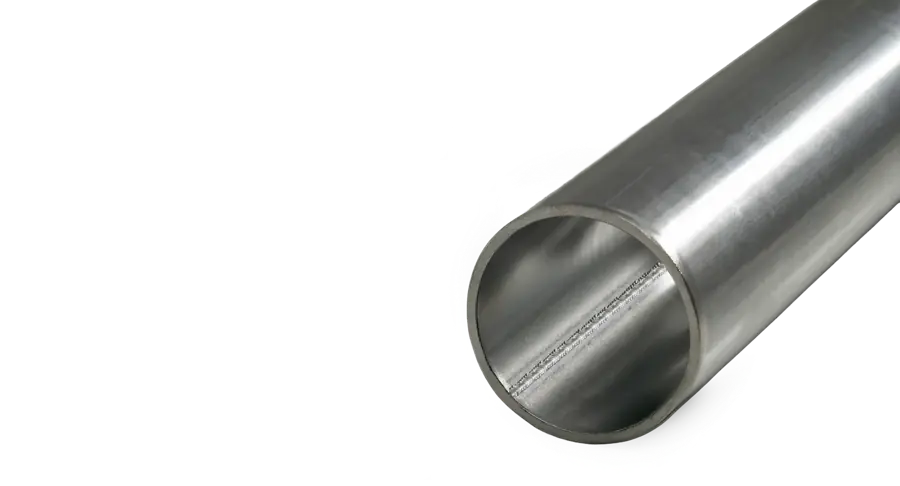
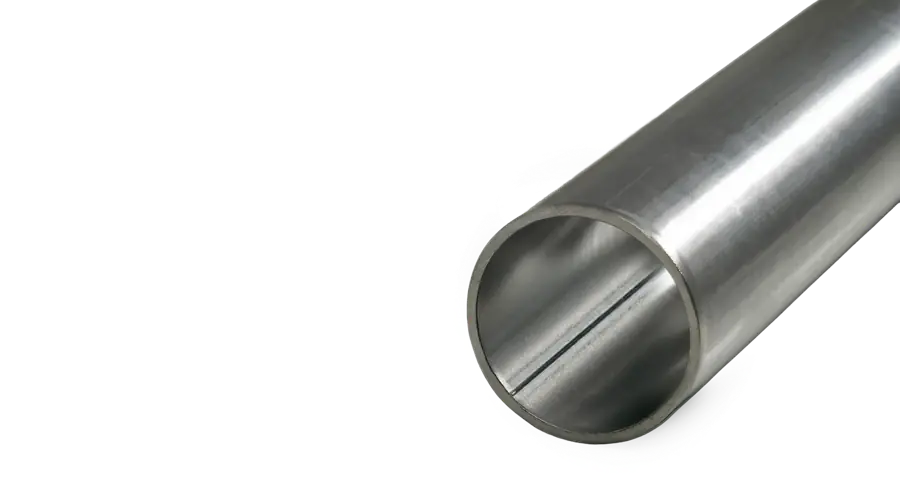
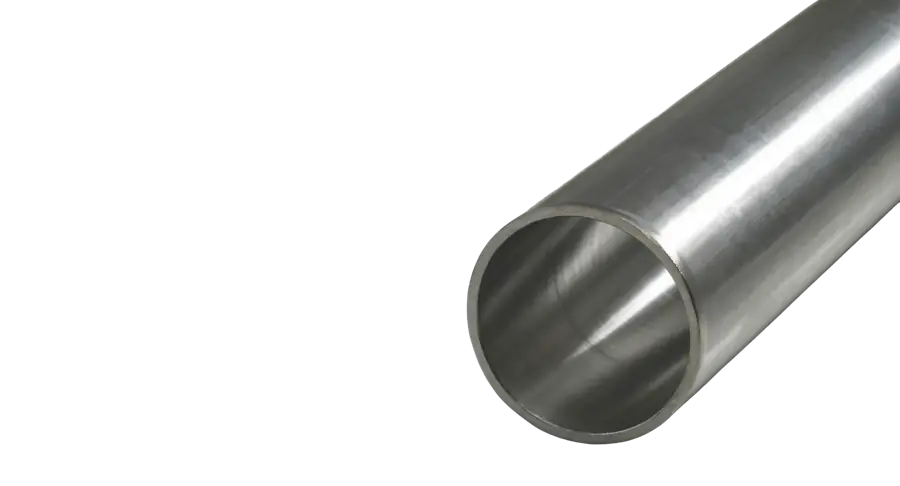
For structural sections where articulation is not required but rather perfect alignment, bending stiffness and an impeccable surface free of waviness, the use of precision welded steel tube according to standard EN 10305-3 represents the preferred industrial standard. This rigid tube provides the necessary bending strength to raise the luminaire without buckling, while the machined terminals allow inserting, laser welding or threading the end of the flexible tube with millimetric tolerances.
For high-end applications and contract lighting projects, manufacturers integrate components from the PRECISE range of calibrated tolerances, ensuring an exact concentric fit between the turned terminal adapter and the inner diameter of the structural tube, eliminating visible play and ensuring the continuity of the grounding on the metal chassis.
Surface treatments and wear protection
Since the flexible tube is directly handled with hands throughout its operational life, the requirements for the surface coating go beyond mere visual aesthetics. The finish must tolerate human sweat (lactic acid and chlorides), continuous friction between moving coils, and residual heat transferred by the lighting fixtures.
Electrolytic chrome and nickel plating
It is the quintessential finish for architectural and hospitality luminaires. The process requires a preliminary layer of copper and bright nickel before the final chromium deposition. The technical difficulty lies in the homogeneous penetration of the galvanic bath between the grooves of the turns without altering the internal friction coefficient of the flexible conduit. An unbalanced deposition thickness can generate micro-cracks in the coating that lead to peeling after several flexions.
Epoxy and polyester powder coatings
For matte black, white, or corporate colors, thermosetting powder paint offers excellent adhesion and a pleasant feel. However, it requires a formulation with high-resilience plasticizers so that the polymer film does not break or crack when the turns open during extreme tube curvature.
Silicone or heat-shrink outer sleeves
In clinical environments, cleanrooms, or food lighting, the open grooves of the flexible tube can accumulate dust, microorganisms, or cleaning products. For these uses, an extruded food-grade silicone sleeve or smooth heat-shrink polyolefin is incorporated, maintaining the internal mechanical joint and providing the exterior with IP65 tightness and ease of disinfection.
Calculation and sizing criteria for product engineers
When specifying a flexible metal tube for luminaires, technical teams must document a rigorous set of operating parameters before launching manufacturing:
- Static bending moment (Holding torque): Measured in Newton-meters (N·m), it represents the tube's ability to support the mass of the light fixture at a given distance without sagging due to gravity. Basic formula: M = F · d, where F is the weight of the optical assembly (N) and d is the maximum extended horizontal lever arm (m).
- Internal working diameter (ID): Required internal free diameter for the loose passage of single-core or two-core cabling and its thermal insulation (PTFE, silicone, or PVC), avoiding abrasions during repeated movements.
- Length of the flexible section versus rigid sections: Minimizing the flexible length to the strictly necessary zone reduces accumulated fatigue and lowers the unit cost of the assembly.
- Type of end termination: Male or female threads (M8x1, M10x1, 1/4″ BSP, etc.), smooth terminals for welding, or press-fit bushings using countersunk set screws.
To deeply understand how these tubular solutions integrate into the luminaire manufacturing ecosystem, you can consult our specialized section on technical lighting tube solutions.
Common mistakes in the specification of flexible tubes for luminaires
In the industrialization process of a luminaire, design flaws are often made that compromise the perceived quality of the final product:
- Underestimating the weight of the LED heat sink: The replacement of traditional halogen bulbs with integrated LED modules introduced heavy aluminum heat sinks. If the support torque of the flexible arm is not recalculated, the head will inevitably drop after a few months of use.
- Ignoring internal cable friction: A cable with an outer diameter too tight to the inside of the tube experiences shearing and tension during torsion, which can tear the insulation or limit the permissible rotation angle of the tube.
- Mounting threaded terminals without anti-rotation locking: When orienting the lamp, the user usually applies combined angular torsion movements. If the threaded terminals lack flat anti-rotation recesses or thread-locking adhesives, the tube will unscrew from the electrical base.
- Forgetting functional earth grounds: Given that the flexible tube is composed of coils with dry lubrication or surface oxide layers, electrical continuity is not always perfect; a dedicated ground connection via an independent cable to the head must be ensured.
Conclusion: mechanical reliability and specialized support
The flexible metal tube for lamps is much more than an articulated accessory: it is a critical structural component that defines the ergonomics, electrical safety, and longevity of any adjustable luminaire. The correct combination of diameters, wire alloys, high-resistance surface treatments, and an adequate transition with rigid tubes guarantees play-free luminaires with impeccable performance over the years.
At Delmàs Tubes we supply precision tubular solutions adapted to the mechanical and aesthetic specifications of the lighting industry. If your engineering department requires technical advice on tolerances, cutting to size, or the combined supply of rigid and flexible tubes, we invite you to contact our engineering team to evaluate the needs of your next project.
Frequently asked questions
What distinguishes a flexible lighting tube from an electrical corrugated conduit?
The flexible lamp tube features a pre-stressed internal structure that gives it self-supporting (stay-put) capability, allowing it to maintain its position after being manually bent. In contrast, a corrugated conduit does not retain its shape and only serves to protect passive cables.
How is the maximum weight that a gooseneck arm can support calculated?
The maximum permissible weight depends on the length of the arm and the internal retention torque of the tube (expressed in N·m). The greater the extension of the horizontal arm, the lower the mass the end can support before yielding to gravity.
Is it possible to paint the flexible metal tube with custom colors?
Yes, flexible tubes can receive epoxy or polyester powder coatings in any RAL shade, provided that elastic powders specially formulated to accompany the deformation of the coils without cracking are used.
Why does the flexible tube sometimes get hot near the spotlight?
The heating is usually due to direct thermal conduction generated by the LED module or bulb if the heat sink is not thermally decoupled from the threaded terminal, and not due to internal friction. It is crucial to choose materials and internal cables that resist up to 105 °C or 150 °C.
Which alloy is recommended for luminaires installed in sanitary environments?
For hospital environments, dental clinics, and laboratories, AISI 304 stainless steel or tubes coated with a continuous heat-sealed silicone sleeve are recommended, as they resist frequent contact with chlorinated disinfectants and alcohols.